Professional Truck Parts Supplier

- All
- Product Name
- Product Keyword
- Product Model
- Product Summary
- Product Description
- Multi Field Search
Views: 0 Author: Site Editor Publish Time: 2026-09-24 Origin: Site


Commercial fleets bleed money every time a rear lighting system fails. A single burnt-out bulb often triggers immediate DOT violation fines, out-of-service (OOS) orders, and unexpected route downtime. The commercial aftermarket is currently flooded with low-tier, non-compliant lighting products. These inferior units routinely fail under the intense vibration, moisture, chemical exposure, and temperature extremes typical of heavy-duty applications. Fleet managers need a systematic evaluation framework for selecting truck tail lights based on strict legal compliance, environmental durability, electrical compatibility, and seasonal operating conditions. Upgrading rear lighting is a critical safety and maintenance decision that directly impacts your operational efficiency and bottom line. We will break down exactly what to look for when outfitting your trailers and tractors to keep them on the road and out of the inspection bay.
Compliance is Non-Negotiable: Any selected lighting must explicitly meet DOT and FMVSS 108 standards, including proper reflex reflectivity, to avoid fleet liability and OOS orders.
LEDs Drive Maintenance Costs Down: While upfront costs are higher, LED truck tail lights eliminate the frequent bulb replacements and vibration-induced failures of incandescent options.
Environmental Sealing Dictates Lifespan: For heavy-duty applications, IP67 is the baseline, but IP69K is required for vehicles subjected to high-pressure washdowns and severe weather.
Winter Operations Require Specialized Tech: Standard LEDs do not generate forward heat; fleets operating in northern climates must specify heated LED truck tail lights to prevent dangerous snow and ice accumulation.
Wiring is the Weak Link: Upgrading the light housing is ineffective if the wiring harness and connection points (e.g., PL-3, Weatherpack) are not protected against galvanic corrosion.
Table of Contents
The legal baseline for commercial vehicle lighting is strictly governed by the Department of Transportation (DOT) and Federal Motor Vehicle Safety Standard (FMVSS) 108. When a commercial vehicle pulls into a weigh station, inspectors look straight at the lighting. These regulations dictate the exact photometric output, viewing angles, and physical placement of rear lighting on commercial vehicles. Verifying compliance requires a physical inspection of the lens. Authentic, compliant units feature permanent DOT and SAE identification codes molded directly into the plastic.
SAE Identification Code | Lighting Function | FMVSS 108 Requirement Notes |
|---|---|---|
S or S2 | Stop Lamps | Must activate immediately upon brake application. |
T or T2 | Tail Lamps | Continuous illumination during low-light operation. |
I or I6 | Turn Signal Lamps | Must flash at a compliant rate (60-120 flashes per minute). |
A | Reflex Reflectors | Required on the rear to reflect light from trailing vehicles. |
Purchasing unverified offshore products introduces severe liability risks. If an uncertified light fails or underperforms during a nighttime collision, the fleet assumes full legal negligence. Functional requirements cover stop, turn, and tail illumination. A critical distinction exists regarding reflex reflectors. Some housings feature built-in reflex reflectors, meeting FMVSS 108 requirements independently. Housings without internal reflectors mandate the installation of separate reflective tape or external modules to remain street legal. Missing this detail results in an immediate citation.
High-quality truck tail lights help reduce long-term maintenance costs by lowering replacement frequency and preventing unexpected downtime. A failed light can cause safety issues, inspection problems, and costly roadside repairs. Choosing durable, sealed lighting units allows fleets to spend less time on emergency repairs and more time on regular maintenance and daily operations.
LED truck tail lights offer longer service life and better durability than traditional incandescent bulbs. LEDs can operate for much longer periods while using less power, reducing stress on the truck’s electrical system and lowering replacement frequency. Their solid-state design also handles vibration and shock better, making them more reliable for heavy-duty trucks, trailers, and rough working environments.
Transitioning to LEDs introduces a major safety gap in cold climates. LEDs run highly efficient and cool, meaning they do not generate forward heat. Traditional incandescent bulbs naturally melt snow and ice off the lens. During severe winter weather, standard LED lenses quickly accumulate opaque layers of ice, rendering the vehicle invisible from the rear. This phenomenon, known as snow blindness, causes massive rear-end collision risks.
Fleets operating in northern climates must utilize smart-heated LED truck tail lights. These advanced units feature internal thermostats that monitor ambient temperatures. When temperatures drop below freezing, the thermostat automatically activates an internal heating grid. This grid warms the polycarbonate lens, actively melting snow and preventing dangerous ice buildup during transit.
Modern truck tail lights may include features such as sequential turn signals and flashing brake patterns to improve visibility. These functions help attract the attention of following drivers, especially in busy traffic or poor weather conditions. However, smart lighting features must still meet FMVSS 108 requirements and cannot replace standard brake and turn signal functions.
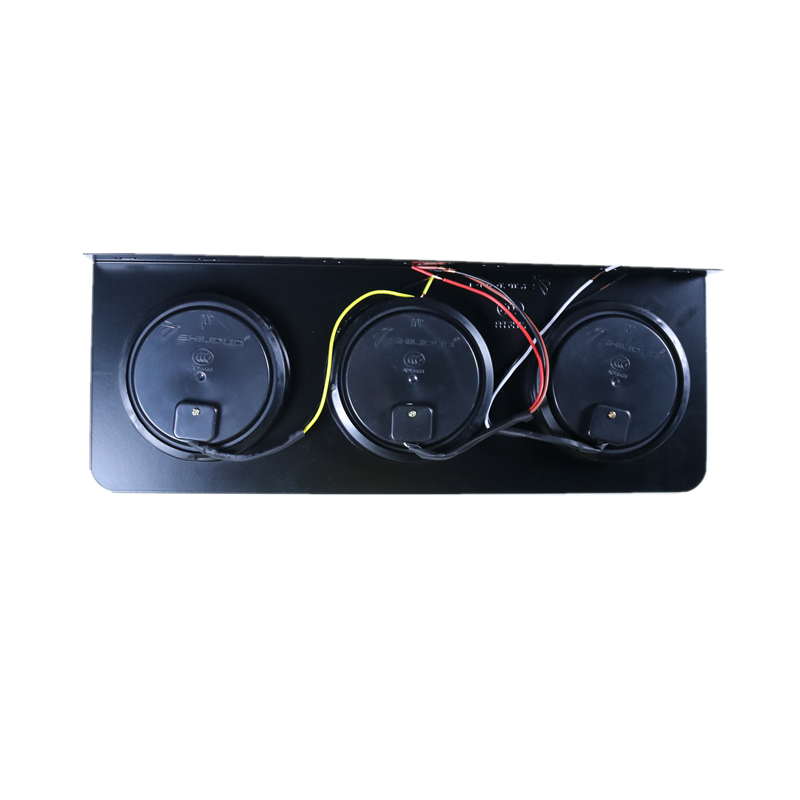
Moisture intrusion destroys electrical components rapidly. Ingress Protection (IP) ratings define a housing's ability to keep water and dust out. An IP67 rating indicates the unit is fully dust-tight and can survive submersion in water up to one meter deep for 30 minutes. This rating serves as the absolute baseline for standard over-the-road applications.
However, vocational trucks, dump trucks, and severe-duty fleets require IP69K certification. The IP69K rating guarantees resistance to high-pressure, high-temperature washdowns. Fleet wash bays use harsh chemicals and high-pressure wands that easily blow past standard seals. Vehicles exposed to corrosive road salts, magnesium chloride, chemical washes, and extreme mud require this superior level of environmental sealing to prevent premature failure.

Heavy-duty commercial suspensions are notoriously stiff. They transfer immense kinetic energy directly to the rear of the chassis and trailer doors. Standard circuit boards quickly fail under this continuous harmonic abuse. Internal potting is a mandatory feature for severe-duty applications.
Potting involves encasing the internal circuit board and diode connections in a hardened epoxy resin. This solid block of epoxy prevents solder joint fractures and diode detachment. It locks every delicate component in place, ensuring the light survives years of punishing road conditions without flickering or failing. If you run off-road or vocational routes, unpotted lights will shake themselves to pieces within months.
The physical lens acts as the primary defense against road debris and environmental damage. Polycarbonate offers exceptional impact resistance. It flexes upon impact, resisting shattering from flying gravel, ice chunks, and minor backing impacts at loading docks. When a forklift bumps the rear sill of a trailer, a polycarbonate lens will often survive the flex.
Acrylic lenses provide slightly better baseline UV resistance but are highly rigid and prone to cracking under physical stress. Polycarbonate is the definitive recommendation for heavy-duty applications. To mitigate polycarbonate's susceptibility to UV degradation, premium manufacturers apply specialized UV-resistant hard coatings. These coatings prevent the plastic from yellowing, clouding, or becoming brittle after years of direct sun exposure.
Maintaining industry-standard sizes ensures seamless retrofitting without requiring structural modifications to the trailer. The 4-inch round and 6-inch oval formats dominate the industry for recessed trailer and rear-chassis mounting. These standard cutouts allow fleets to swap brands or upgrade technologies in minutes without pulling out a grinder or welder.
Stud-mounted box lights serve specific tractor and vocational applications where recessed mounting is impossible. Box lights often incorporate multiple functions, including stop, turn, tail, and license plate illumination, into a single external housing. They bolt directly to the frame rail or custom brackets.
Selecting the correct mounting style dictates installation speed and physical security for your lighting investments.
Mounting Style | Primary Benefits | Ideal Fleet Applications |
|---|---|---|
Grommet Mount | Excellent shock absorption, rapid replacement without tools. | Standard dry vans, flatbeds, and over-the-road trailers. |
Flange Mount | High physical security, tamper-proof hardware compatibility. | High-theft areas, equipment trailers, and heavy-duty chassis. |
Surface Mount | Requires minimal drilling, preserves structural integrity. | Refrigerated trailers, vocational bodies, and custom builds. |
Grommet mounts utilize thick rubber or PVC rings that absorb road shock and allow technicians to pop out failed units instantly. Flange mounts integrate a hard plastic or metal ring directly into the housing. This allows the use of anti-theft security rings and tamper-proof rivets to protect high-value LED investments. Surface mounts are utilized when cutting a large housing hole is not structurally viable or would compromise the thermal insulation of a refrigerated trailer wall.
The physical connection dictates the reliability of the entire lighting system. Standard connection types include the PL-3 three-prong plug, sealed Weatherpack connectors, and hardwired pigtails. Sealed Weatherpack connectors provide superior defense against moisture wicking through silicone seals.
Multi-voltage compatibility (12V/24V systems) is highly advantageous for mixed fleets or cross-border operations where tractor voltage may vary. Furthermore, modern smart-trailer telematics and CAN bus systems monitor electrical loads to report light outages directly to the cab. Upgraded lighting must feature compatible circuitry to communicate accurately with these onboard diagnostic systems without throwing false error codes.
Evaluating lighting upgrades requires looking past the initial purchase order. A cheap incandescent unit offers no warranty and guarantees future labor costs for replacement. A premium LED unit requires a larger initial investment but often includes a multi-year or lifetime warranty. Fleet managers must rigorously evaluate manufacturer warranties. Look for loopholes regarding partial diode failure, moisture intrusion, and chemical corrosion. A robust warranty should cover the entire sealed unit against any environmental or manufacturing defect. High-quality units pay for themselves by eliminating future maintenance cycles and keeping the trailer on the road.
Standardizing a fleet on universal truck tail lights drastically reduces parts complexity. Stocking standard 4-inch round or 6-inch oval units allows mechanics to service any trailer in the yard instantly. This universal approach minimizes inventory overhead and simplifies training.
Contrast this with the necessity of OEM-specific modules found on newer, aerodynamically integrated trailer designs. Some modern trailers utilize custom-molded light housings to reduce aerodynamic drag. Installing universal lights on these specific trailers can create fitment gaps or disrupt the aerodynamic profile. Fleets must balance the aerodynamic benefits of OEM designs against the logistical simplicity of universal components.
Selecting heavy-duty lighting components represents a critical risk-management and safety decision, extending far beyond a routine parts purchase. Reliable rear illumination protects the fleet from liability, prevents rear-end collisions, and maximizes route uptime. Follow these actionable steps to optimize your fleet's lighting strategy:
Audit your current lighting failure rates to identify recurring issues with specific mounting styles or connection points.
Standardize your fleet's mounting sizes to universal 4-inch round or 6-inch oval formats to streamline inventory management.
Prioritize IP67 LED units with standard grommet mounts and PL-3 connectors for standard over-the-road fleets.
Mandate smart-heated LED lenses for vehicles operating in northern or winter routes to prevent snow blindness.
Request physical test units from reputable commercial suppliers to verify build quality and connector compatibility before executing a bulk fleet retrofit.
A: The LED technology itself is perfectly legal, but the specific housing and lens must be rigorously tested. To be DOT approved, the light must meet FMVSS 108 standards for brightness, color, and viewing angle. Always look for permanent DOT and SAE stamps molded directly into the lens to verify compliance before installation.
A: Standard LED lights operate very efficiently and do not generate enough forward heat to melt snow or ice. This can cause dangerous snow accumulation on the lens. For winter fleet operations, you must install specialized heated LED lights equipped with internal thermostats and heating grids to keep the lens clear.
A: Premium LED lights are designed to outlast the vehicle itself, typically offering an operational lifespan of up to 100,000 hours. This is a massive improvement over traditional incandescent bulbs, which generally burn out after 1,000 to 2,000 hours of use, drastically reducing ongoing maintenance requirements.
A: An IP67 rating means the light is completely dust-tight and can withstand temporary submersion in water up to one meter. An IP69K rating offers superior protection, ensuring the light can withstand high-pressure, high-temperature water jets. IP69K is essential for vocational trucks exposed to aggressive chemical washdowns.
A: Hyper-flashing occurs because LEDs draw significantly less power than incandescent bulbs. Your truck's traditional thermal flasher relay interprets this low power draw as a burnt-out bulb. To fix this, replace the thermal flasher with an electronic LED flasher relay, or install load resistors into the wiring harness.
A: Switching between mounting styles usually requires modifying the mounting surface. Flange-mount lights are screwed or riveted directly to the surface, while grommet-mount lights require a specific, larger cutout to accommodate the rubber shock-absorbing ring. Ensure your trailer has the correct structural cutout before attempting to swap mounting styles.


