Professional Truck Parts Supplier

- All
- Product Name
- Product Keyword
- Product Model
- Product Summary
- Product Description
- Multi Field Search
Views: 0 Author: Site Editor Publish Time: 2026-09-24 Origin: Site


Driving heavy-duty rigs at night exposes the severe limitations of aging factory lighting. When you tow heavy loads or navigate off-road trails in bad weather, poor forward visibility directly compromises safety. Factory halogen setups degrade fast. The lenses cloud over, and the filaments lose their output, cutting your reaction time down to nothing. Upgrading seems straightforward until you hit the aftermarket. You immediately run into exaggerated lumen claims, mismatched bulb-to-housing setups, and non-compliant parts that blind oncoming traffic. We built this guide to cut through the marketing noise. We focus strictly on the mechanical and electrical realities of upgrading truck headlights. You need to match bulb technology to the correct housing, manage electrical loads, and maintain street legality. This framework gives you the exact specifications needed to build a reliable, high-output lighting system.
Housing Dictates Technology: Placing an LED or HID bulb into a standard halogen reflector housing scatters light dangerously; matching the bulb technology to the correct projector or reflector assembly is non-negotiable.
Lux Over Lumens: Raw lumen output is a misleading marketing metric; usable light (Lux) and a precise beam pattern determine actual road visibility and safety.
Compliance Matters: Upgrading truck headlights requires navigating DOT/SAE compliance to ensure street legality and avoid liability.
Electrical Integration: Modern trucks require CAN bus compatibility; upgrading often necessitates anti-flicker modules or load resistors to prevent dashboard errors and power cycling.
Holistic Upgrades: Installing premium bulbs in oxidized or cloudy housings yields minimal gains; assessing lens clarity and replacing bulbs in pairs are critical best practices.
Table of Contents
Before upgrading truck headlights, check the current bulb type, connector, and wiring condition. Inspect the harness for heat damage, corrosion, or previous modifications that may affect compatibility. Measuring voltage at the connector can also identify power loss issues and determine whether additional wiring upgrades are needed.
Cloudy or yellowed headlight lenses can reduce light output and weaken beam performance. UV damage and road debris can make the lens scatter light instead of focusing it on the road. Minor oxidation can be restored through polishing, but severely damaged lenses usually require complete replacement.
Reflector and projector headlights use different optical designs. Reflector housings spread light using reflective surfaces, while projector housings use lenses and cutoff shields to create a more focused beam. Using incompatible bulbs with the wrong housing can create poor visibility and excessive glare for other drivers.
The upgrade method depends on the original headlight system. Factory halogen headlights usually allow simple bulb replacement, while factory LED systems often require full assembly replacement because the LED components are integrated into the housing. Choosing compatible aftermarket assemblies helps maintain proper performance and installation reliability.
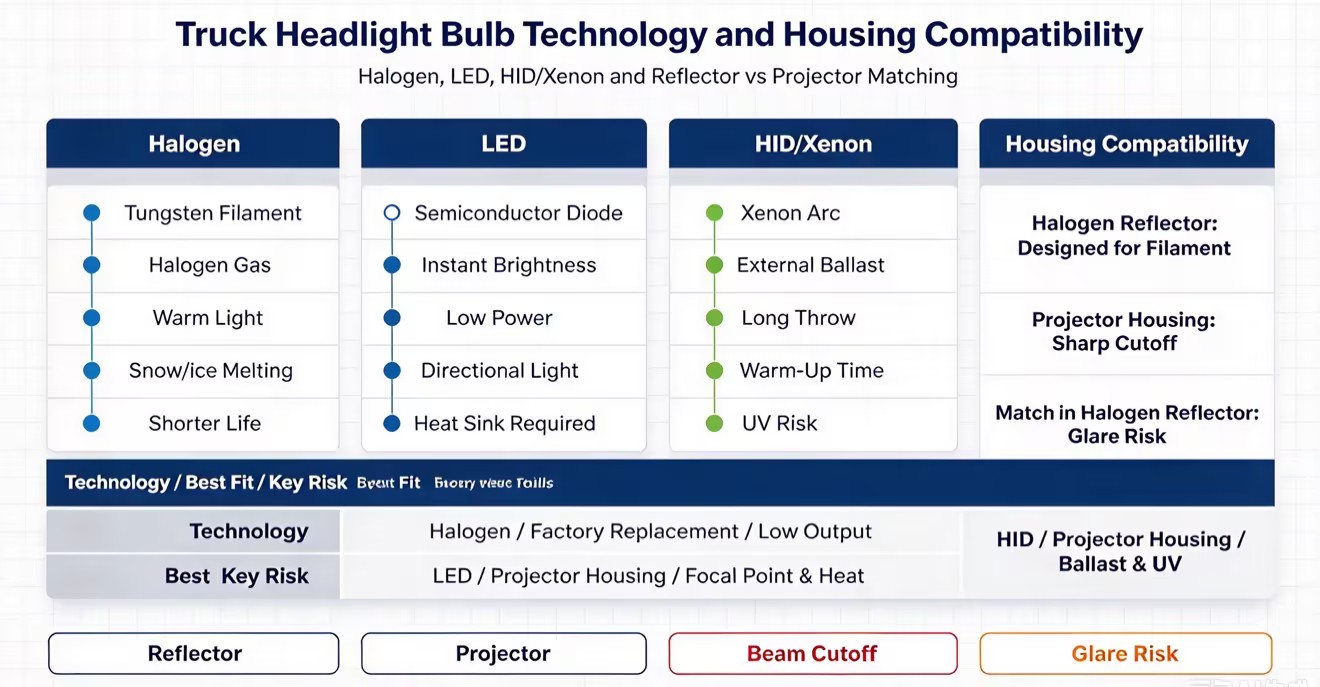
Halogen headlights use a tungsten filament inside a halogen gas-filled bulb to produce light. They are reliable, affordable, and compatible with most factory housings. However, they provide lower brightness, shorter lifespan, and a warmer yellow light compared with newer lighting technologies.
LED headlights use semiconductor technology to produce brighter light with lower power consumption. They are more resistant to vibration and provide instant illumination, making them suitable for trucks and off-road use. However, LEDs require proper heat management and accurate chip positioning to maintain the correct beam pattern.
HID/Xenon headlights create light through an electrical arc inside a xenon gas tube. They provide strong brightness and longer-distance illumination compared with halogen bulbs. However, they require additional components such as ballasts, need warm-up time, and may create heat or UV-related risks for some headlight housings.
Technology | Mechanism | Primary Advantage | Primary Disadvantage |
|---|---|---|---|
Halogen | Tungsten filament in halogen gas | Melts snow/ice, guaranteed fit | Short lifespan, lower output |
LED | Semiconductor electroluminescence | Instant on, vibration resistant | Requires bulky cooling, CAN bus issues |
HID/Xenon | Electrical arc in quartz tube | Exceptional distance throw | Requires external ballasts, warm-up time |
A simple bulb replacement is suitable when the original headlight housing is still in good condition. If the lens is clear and the reflector works properly, upgrading the bulb can improve brightness while keeping the original beam pattern. This option is easier, more affordable, and avoids replacing the entire headlight assembly.
Replacing truck headlights in pairs ensures balanced lighting performance. An old bulb and a new bulb usually have different brightness and color output, which can create uneven road illumination. Installing two new bulbs at the same time improves visibility and provides a more consistent driving experience.
A complete headlight assembly upgrade is recommended when changing lighting technology or improving overall performance. New housings provide better optical design, beam control, and modern features such as LED styling, daytime running lights, and improved lenses. They offer a more complete lighting solution compared with simple bulb replacements.
Bulb replacement may have a lower initial cost, but low-quality bulbs can require frequent replacement. A complete headlight upgrade with proper optics and thermal management can provide better durability, more stable performance, and lower maintenance needs over time.
Raw lumens only show the total light output, but they do not represent real driving performance. A good headlight needs proper beam control to focus light on the road and avoid glare for other drivers. A clear cutoff line and strong Lux performance provide better visibility than simply choosing a bulb with higher lumen numbers.
Headlight color temperature affects visibility in different weather conditions. Yellow light around 3000K performs well in fog, rain, and snow, while 4300K to 5000K provides a natural white light suitable for normal driving. Extremely high color temperatures above 6000K may create more glare and reduce visibility in bad weather.
Truck headlights must meet road safety standards such as DOT and SAE requirements. Compliant headlights are designed with proper beam patterns, brightness control, and glare limits. Always check for official markings on the product before installing headlights for public road use.
Choosing a reliable headlight brand requires checking product quality, warranty support, and long-term durability. Good headlights should have effective heat management, protected electronics, and resistance to moisture and vibration. Customer reviews and real-world usage feedback can also help evaluate product reliability.
Upgrading your lighting system requires matching the right technology to your specific driving conditions and vehicle architecture. Follow these exact steps to finalize your lighting upgrade:
Pull your factory bulbs and verify the exact part number stamped on the base before ordering replacements.
Inspect your factory wiring harness for melted connectors, exposed copper, or heavy corrosion.
Measure the physical clearance behind your headlight housing to ensure aftermarket heat sinks will fit without hitting the battery or airbox.
Order extended rubber dust covers if your new setup requires modifying the factory seals.
Aim your headlights against a wall at 25 feet immediately after installation to ensure the cutoff line sits below the sightline of oncoming traffic.
A: LED assemblies are legal for on-road use only if the entire housing is DOT/SAE compliant and stamped accordingly. Dropping aftermarket LED bulbs into factory halogen reflector housings is generally not DOT approved for street use, as it alters the focal point and creates dangerous glare for oncoming traffic.
A: It is highly discouraged. Halogen reflectors are designed for the 360-degree light emission of a filament. LEDs emit light directionally. Placing an LED in a halogen reflector scatters the beam, creating a blinding glare for other drivers while actually reducing your usable forward visibility.
A: Headlight bulbs degrade at a similar rate based on operating hours. If one fails, the other is nearing the end of its life. Replacing them in pairs ensures even illumination, prevents eye strain from mismatched brightness, and saves you from repeating the installation process shortly after.
A: A color temperature around 3000K to 4300K is optimal for rain, fog, and snow. Yellow-tinted light cuts through airborne moisture effectively and reduces the harsh glare that reflects back into the driver's eyes. Avoid blue tints above 6000K as they scatter heavily in bad weather.
A: Flickering is usually caused by the truck's CAN bus system or a Pulse Width Modulation (PWM) signal. LEDs draw less power than factory halogens and react instantly to voltage pulses. Installing an anti-flicker module or capacitor corrects the electrical signal and stops the flickering.
A: The most accurate method is to remove your current bulb and read the part number stamped directly on its plastic or metal base. You can also consult your vehicle's owner's manual or check the factory markings molded into the rear of the headlight housing assembly.


